From oxides to organics: a new MBE platform for organic semiconductors at PDI
/ Announcements
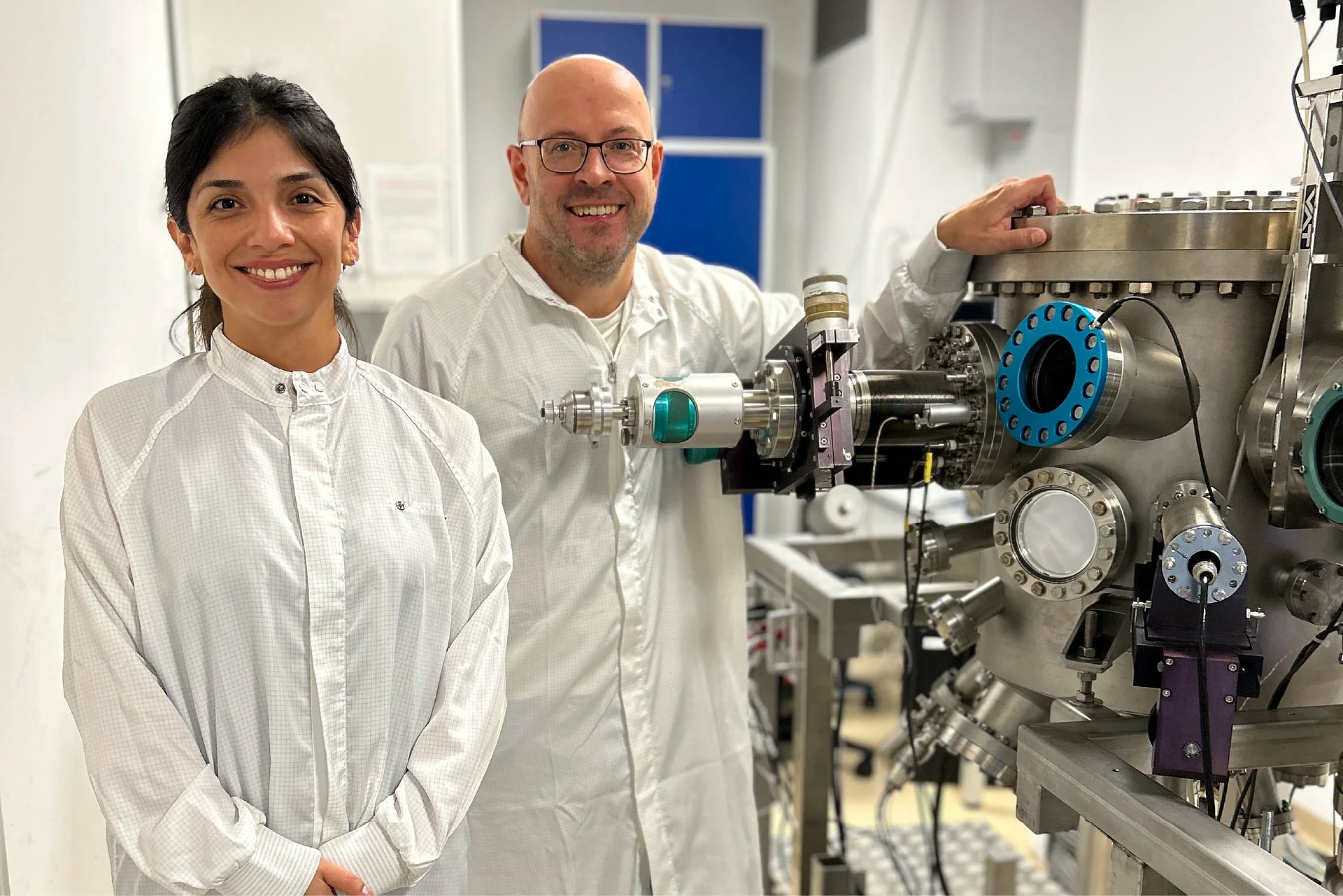
PDI is internationally recognized for molecular beam epitaxy (MBE) of inorganic semiconductors. Now the institute is bringing that expertise to an entirely different class of materials. PDI's Francisca Marín Largo and Carsten Stemmler have established a new MBE platform dedicated to the growth of organic semiconductors.
Rather than starting from scratch, the two took a former oxide MBE chamber and rebuilt it for its new purpose. Organic molecules make different demands on a growth system than inorganic materials do. They evaporate at far lower temperatures and are sensitive to decomposition and contamination. Meeting these demands meant characterizing the evaporation behavior and thermal stability of organic materials through preliminary residual gas analysis (RGA) in a separate vacuum chamber, establishing suitable evaporation temperatures, and considering material purification and handling to minimize contamination and moisture exposure. Through their initiative and dedication, the chamber is now a purpose-built platform for controlled molecular growth with in-situ characterization — the first of its kind at PDI.
The system is being prepared for its first growth experiments, starting with perylene-3,4,9,10-tetracarboxylic dianhydride (PTCDA) as a model material to calibrate the system and establish suitable growth conditions for organic semiconductors. Future work will explore organic semiconductor materials for solar-cell applications, with a focus on molecular orientation, π-stacking and organic/inorganic semiconductor interfaces.
This new MBE platform shows how the institute’s long-standing experience in high-precision epitaxy can open doors well beyond its traditional material systems.