"I'm Looking Forward to Being the Elephant in the Room" Interview with Emma Wood, PDI Artist-in-Residence 2026
/ Interviews
Tell us about your journey into weaving — how did you first find your way into the craft?
I’ve always been drawn to textiles and I grew up and trained in the UK, where there is a strong history of textile design & engineering. I started my studies by working across all textile disciplines (print, knit, embroidery, etc), but something clicked with weaving, like I had found the tactile, visible version of how my mind works. We’re so used to being told that in order to be creative we need to “think outside the box”. But weaving has very real limitations and requires very strict planning, and I love the constant challenge of having to work within those restrictions. Thinking inside the box, being innovative within such a structured craft - that’s what first got me into weaving and has kept me there for the past twenty years.
How would you describe your artistic practice to someone who’s never seen your work?
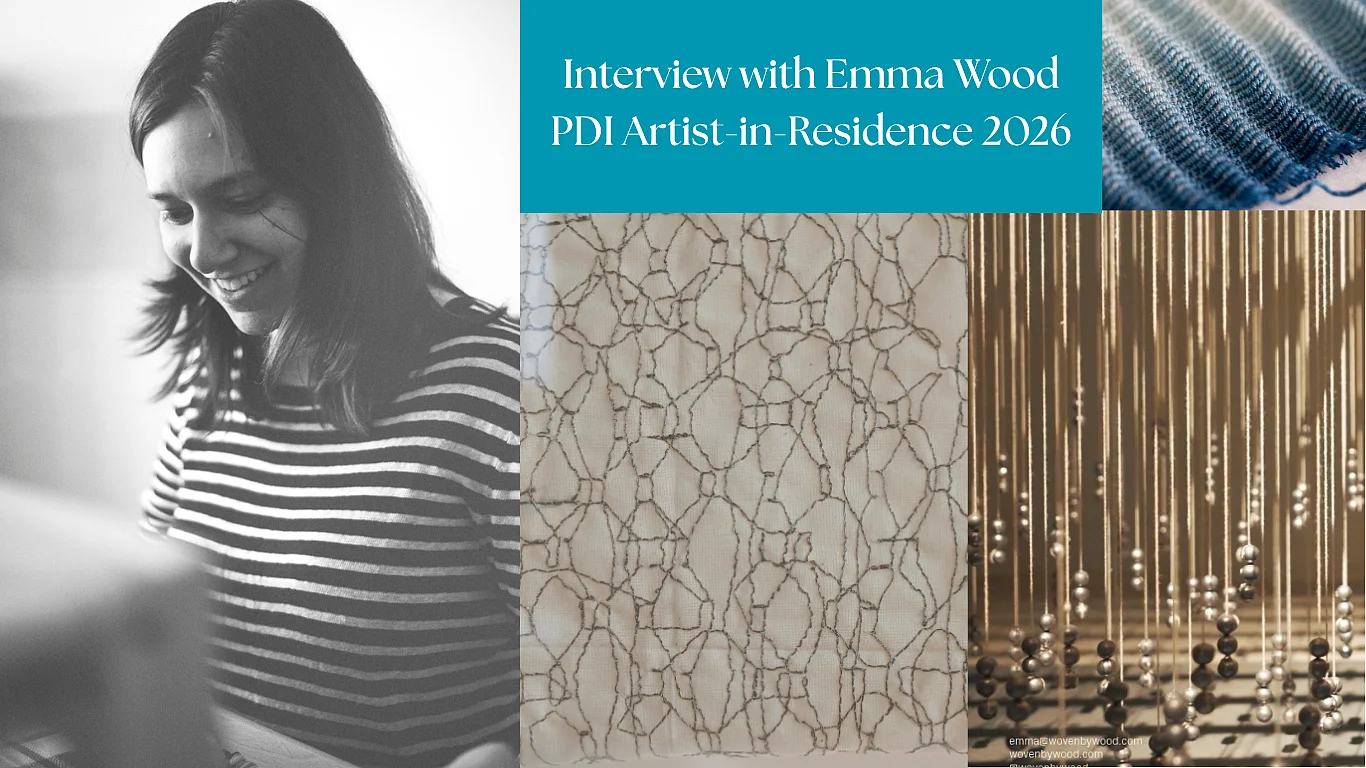
In the simplest terms, I say that I love weaving and my work is an attempt to better understand the craft that has shaped my mind and my body for my entire adult life. When I want to get more specific, I say that I’m interested in how embodied knowledge is formed, the physical impact it makes on our bodies, and how that knowledge and impact can be traced and read in the woven cloth. I explore these themes by merging heritage handweaving techniques with digital tools and technologies to break down and expand the weaving process, creating environments where the audience find themselves submerged within the woven process itself.
What made you apply for the Artist-in-Residence Programme at PDI, a materials science and condensed matter physics institute?
When considering residencies and research projects, the number one thing I’m looking for is to expand my knowledge and challenge the way I think about and work with my craft. I got incredibly excited at the PDI AiR programme because of just how vastly different our fields seemingly are. The residency programme is so open and supportive that it felt I would have space to really dive deep into exploring these differences between physics and weaving. And who knows, maybe they have more in common than I had originally suspected?!
Had you had any prior connection to science or research environments before this?
I’ve been working in artistic research for the last six to seven years. This has included short-term residencies, group research, and long-term independent research projects within academic research institutes. Most of my research has been in the field of electronic textiles (e-textiles), where artistic and technical research methodologies converge.
What do you know about PDI’s research so far, and what’s caught your curiosity?
In all honesty, I actually understand very little about PDI’s research. I read up on the work being carried out by the institute, but it still felt a bit like listening underwater. That’s what caught my attention the most - the chance to enter a new environment that I know so little about, armed only with my curiosity and my shuttle.
What are you most looking forward to during your three months here?
In learning about PDI, I was immediately drawn to the material scale that they work on. In my own practice, I work on a very fine scale and in group projects I’m used to having the smallest pieces/components/materials in the room. But working with PDI will flip that script. My work is on such a macro scale compared to PDI, and it feels clunky and unwieldy by comparison. I’m looking forward to being the elephant in the room.
Do you have any early ideas about what you’d like to explore or is it too early to say?
Oh, I think it’s too early to say - I don’t want to arrive with any predetermined outcomes. But I can give some keywords that have been running through my mind: scale, materiality, lexicon, repetition, embodiment, craft.
What do you hope a conversation between a weaver and a physicist might look like, and what do you think both sides would learn from it?
I’m incredibly well-versed in textiles, but my last physics lesson was when I was sixteen years old (and it was always my weakest subject). For a long time, including in my own research in e-textiles, I’ve allowed this lack of education to intimidate me. Even in my answers to these questions, I’m reluctant to apply physics terminology in case I get it wrong. So I’m hoping to break out of that by being surrounded by people who have the same enthusiasm, knowledge and care for their craft (physics) as I do for mine (weaving). There are going to be new conversations and vocabularies for all of us, and I’m excited to find out what similarities our two crafts might share.
What would success look like for you at the end of this residency?
Artistic residencies should be beneficial for both parties, the artist and the host. Success for me would be the feeling that not only have I been able to learn and develop my creative practice through this new environment, but that I’ve also been able to leave a piece of my practice behind with PDI, offering a new perspective on how artistic research methodologies can play a beneficial role in scientific research.
Emma Wood's residency at PDI runs from October to December 2026. Over these three months, she'll be embedded within the institute, working alongside and exchanging ideas with our scientists as she explores where weaving and materials science might meet. We'll be sharing more stories from her residency on this page as it unfolds.