Unlocking higher efficiency: PDI researchers help identify the hidden limit in organic solar cells
/ Scientific Highlight
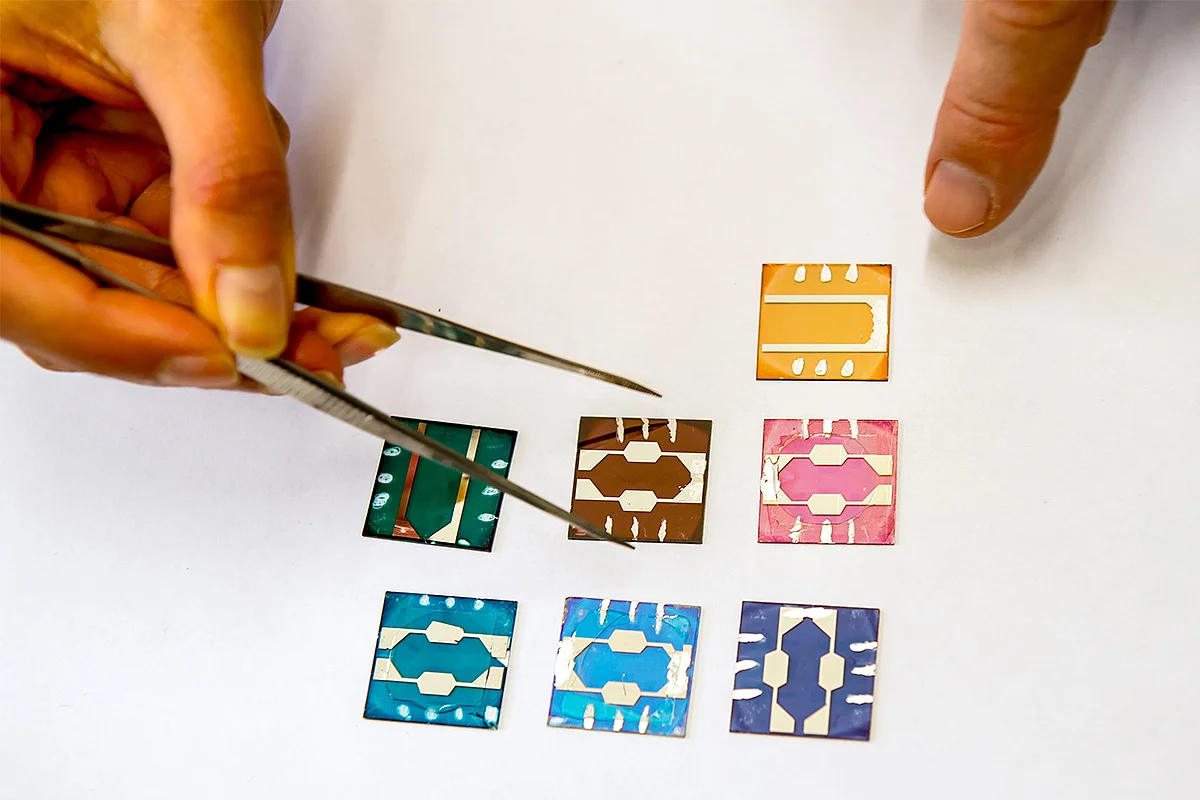
Organic solar cells are thin, flexible, and cheap to produce, making them a promising alternative to conventional silicon panels. But despite years of progress, they have hit a stubborn ceiling: every attempt to push efficiency higher runs into an unexpected obstacle. Improve one performance measure, and another one drops.
This challenge has now been addressed through close collaboration among the research groups of Prof. Feng Gao (Linköping University, Sweden), Prof. Dieter Neher (University of Potsdam), and Prof. Safa Shoaee (PDI, Berlin), together with a team of international researchers. The study was led by first author Huotian Zhang, a joint postdoc in the groups of Safa Shoaee and Dieter Neher, with PDI's Nurlan Tokmoldin and PhD student Mohammad Saeed Shadabroo among the co-authors. Their findings are published in Nature Photonics.
When light hits an organic solar cell, it creates short-lived excited states called excitons — pairs of positive and negative charges held together — that must be pulled apart before they can generate electricity. The team discovered that this separation process can be highly sensitive to the electric field inside the device, and that this sensitivity becomes a growing problem in precisely the materials that are otherwise closest to the efficiency frontier.
How long those excited states survive turns out to matter enormously. The longer they last, the more time they have to split into free charges, reducing the device's dependence on the electric field and recovering lost performance. The team validated this with a new material blend that simultaneously achieved record-level efficiency and charge-extraction efficiency.
Beyond this proof of concept, the work provides a quantitative framework that can guide the design of future organic solar cell materials, offering a clear pathway toward efficiencies that can genuinely compete with silicon.
Title: Overcoming the fill-factor limit of organic solar cells
Authors: H. Zhang, J. Yuan, T. Wang, Y. Nai, N. Tokmoldin, W. Liu, S. Ouyang, R. Jasiūnas, Y. Liu, Y. Li, M. S. Shadabroo, M. Pranav, N. Jain, X. Zhang, V. Coropceanu, A. A. Bakulin, S.-W. Tsang, V. Gulbinas, S. Shoaee, Y. Zou, D. Neher, T. Kirchartz, F. Gao
Source: Nat. Photonics, tba, tba (2026)
DOI: 10.1038/s41566-026-01946-8