A Common Yardstick: Benchmarking Nonlinear Light Generation Across Four 2D Semiconductors
/ Scientific Highlight
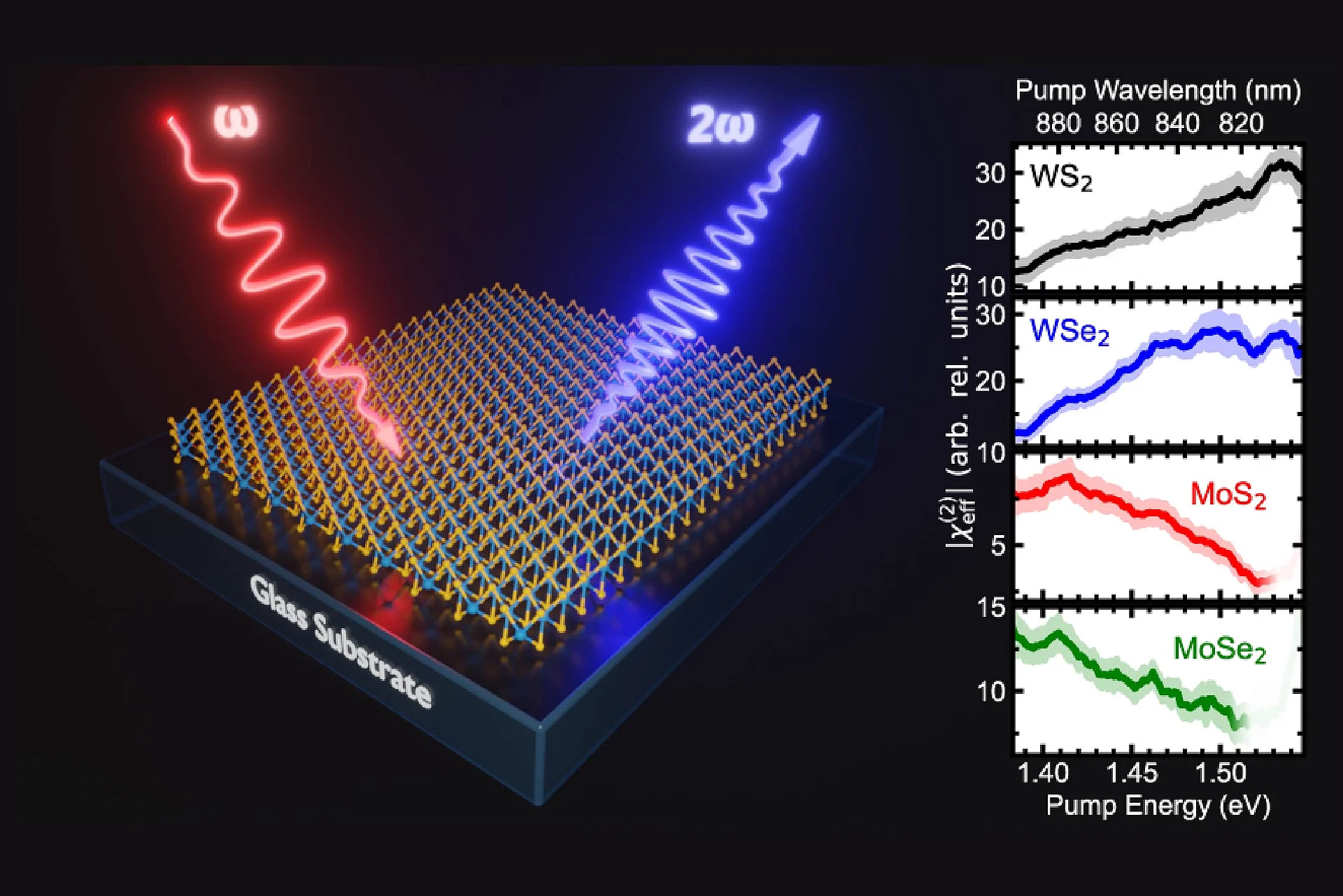
Transition metal dichalcogenide monolayers (TMDCs) lack a center of inversion symmetry, a structural quirk that makes them unusually efficient at second-harmonic generation (SHG): shining light in at one wavelength and receiving emitted light at exactly half that wavelength. This nonlinear response is central to emerging applications in metasurfaces, integrated photonic circuits, and multiphoton bioimaging. A material's SHG efficiency already varies strongly from one TMDC to another, and on top of that it depends sensitively on excitation wavelength, substrate, strain, and encapsulation, so numbers reported by different labs on different substrates under different conditions are hard to compare directly.
A new study addresses this gap by measuring all four common TMDCs, WS2, WSe2, MoS2, and MoSe2, side by side on the same simple platform: mechanically exfoliated monolayers on bare glass. The work is a joint effort between TU Berlin, PDI, UTS Sydney, University of Melbourne, and Singapore Polytechnic, led by co-first authors Nils Bernhardt and Miguel Bacaoco, with Bernhardt being a PhD student supervised by PDI’s Markus R. Wagner. Using calibrated femtosecond SHG microscopy across an 800–900 nm excitation range, with photoluminescence measurements confirming genuine monolayer quality for each sample, the team extracted the effective second-order nonlinear susceptibility, |χ⁽²⁾eff|, for each material under identical preparation and measurement conditions.
The results reveal a clean split by transition metal. The tungsten-based monolayers, WS2 and WSe2, show a nonlinear response that rises with excitation energy across most of the measured range, while the molybdenum-based monolayers, MoS2 and MoSe2, show the opposite trend, along with a weaker overall response on bare glass. Both patterns trace back to so-called C-type excitonic and band-nesting resonances, electronic transitions that shift in energy depending on which transition metal and chalcogen are involved. Density functional theory calculations qualitatively support these trends, reinforcing that the observed dispersion reflects real material physics rather than measurement artifacts.
Comparing these bare-glass results to prior literature reveals just how much substrate and environment matter: measurements on quartz, hBN-encapsulated, or SiO2/Si-backed samples show resonances shifted by tens to over a hundred meV relative to this study, consistent with effects such as dielectric screening and strain that different environments impose. That variability is precisely the problem this benchmark is designed to address, by fixing the substrate and measurement protocol, the study isolates genuine material-to-material differences from environmental artefacts.
The result is a practical reference point for anyone designing glass- or silica-compatible nonlinear photonic devices: a same-platform comparison showing which TMDC, and which excitation wavelength, will deliver the strongest second-harmonic response for a given application. The authors note that translating these relative comparisons into absolute, calibrated susceptibility values will require reference-based calibration and polarization-resolved measurements, a natural next step building on this benchmark.
Title: Spectral dispersion of effective second-order susceptibility in monolayer WS2, WSe2, MoS2, and MoSe2 on bare glass: A systematic comparison for nonlinear photonics
Authors: N. Bernhardt, M. Y. Bacaoco, Y. Q. Chee, J. Guo, M. S. Hossain, N. M. Nguyen, T. T. Tran, S. Ali, N. Medhekar, M. R. Wagner, A. S. Solntsev
Source: ACS Appl. Opt. Mater., 4, 2180-2187 (2026)
DOI: 10.1021/acsaom.6c00257
CReA: 2D Materials