How Trapped Charges Govern the Emission of Light in Gallium Oxide
/ Announcements
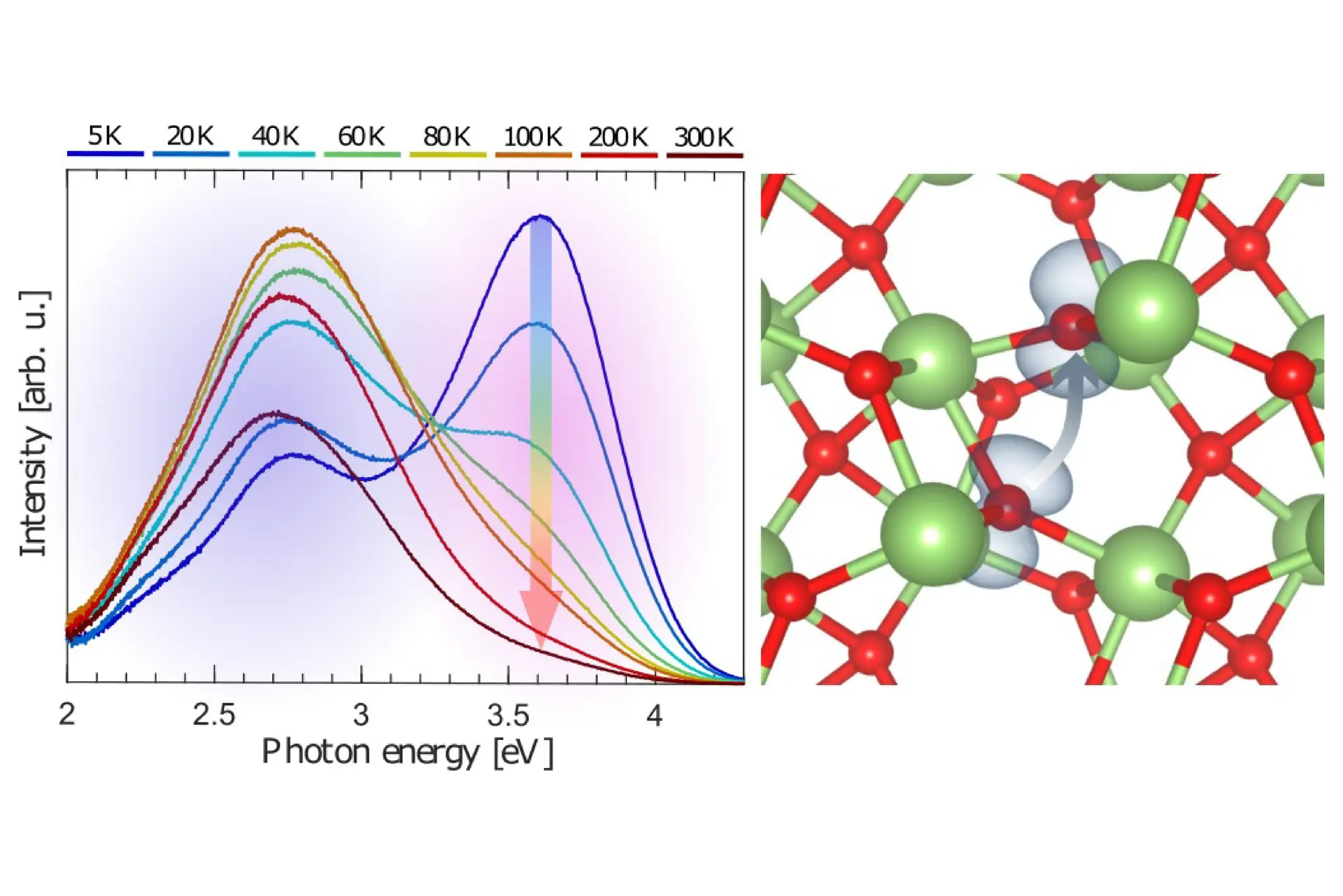
Researchers from the Core Research Area (CReA) Novel Functional Oxide Materials at PDI, together with international collaborators, have uncovered new insights into how charge carriers move and interact in gallium oxide (Ga₂O₃), a key material for the next generation of high-power electronics and ultraviolet optoelectronics.
Ga₂O₃ is known for its ultrawide bandgap, which allows it to withstand extremely high voltages and operate efficiently in demanding environments. Its optical and electronic properties, however, are strongly influenced by the movement of so-called self-trapped holes (STHs), positive charges that locally distort the crystal lattice and become trapped at a specific site. These STHs not only hinder p-type conductivity but also play a crucial role in the material’s distinctive light emission.
In a study recently published in Advanced Functional Materials, the team reports the first identification of STH-related emission in α-Ga₂O₃, alongside a detailed comparison with the better-known β-Ga₂O₃ phase. Using temperature- and polarization-resolved photoluminescence excitation spectroscopy combined with advanced first-principles calculations, the researchers developed a microscopic model that describes how STH migration, defect trapping, and carrier recombination govern the thermal quenching of luminescence - the way the emission of light changes as the crystal heats up.
A major achievement of the study is the quantitative agreement between theoretical predictions and experimental observations: the energy barriers calculated for STH migration closely match the measured quenching behavior in both α- and β-Ga₂O₃. This direct link between atomic-scale motion and optical properties provides a new level of understanding of how defects and charge dynamics shape the material’s luminescence.
The research was led by Markus R. Wagner from PDI and Lasse Vines from the University of Oslo in collaboration with researchers from the University of Leipzig, Technische Universität Berlin, the Leibniz Institute for Crystal Growth, and Lawrence Livermore National Laboratory in the USA.
These findings represent a significant step forward in understanding charge-carrier dynamics in ultrawide bandgap oxides. They provide valuable guidance for defect engineering and the design of Ga₂O₃-based devices such as UV detectors and energy-efficient power electronics.
_________________________________________________________________________
Title: Self-trapped hole migration and defect-mediated thermal quenching of luminescence in α- and β-Ga2O3
Authors: N. Hajizadeh, Y. K. Frodason, C. Petersen, B. M. Janzen, L. Sung-Min Choi, N. Bernhardt, F. Nippert, Z. Galazka, J. B. Varley, H. von Wenckstern, L. Vines, M. R. Wagner
Source: Adv. Funct. Mater., tba, e17876 (2025)
DOI: 10.1002/adfm.202517876
Core Research Area (CReA): Novel Functional Oxide Materials